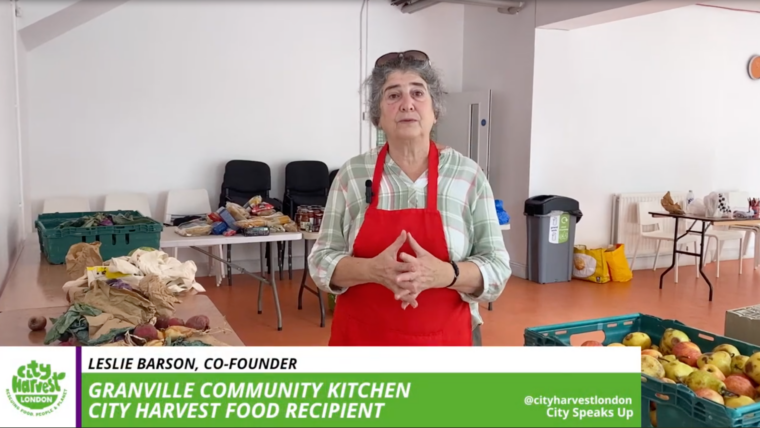

Joe Bastable interviews Leslie Barson to discuss food aid, social housing issues and gentrification in London and across Britain.
” I met Leslie after doing a food collection in North West London with the North London Communist Party Branch, to donate to Granville Community Kitchen. Upon speaking to her I quickly learned that she is incredibly knowledgeable on both housing issues and food aid, in London and across the country. This is due to the tireless work she does for her local community on the South Kilburn Estate. I knew that I had to interview her so that we could learn from her experience and knowledge, especially in relation to our housing campaign and food aid work.”
——Joe Bastable, is a member of the YCL’s London District
We started the interview with Leslie giving me a brief overview of the history of the Granville and what it does.
“Granville community kitchen was formed in partnership between me and my dear friend Deidre Woods. We met through an organisation called the otherwise club which has been at the Granville for nearly 28 years, it’s a community centre for home educators.
At the Granville was this wonderful kitchen which was run by Merle’s diner for many years all through the life of the otherwise club. The whole community used to come to Merle’s diner, it was the heart of building, and when she retired in 2009 the kitchen was empty for quite a few years. Deidre is also a wonderful cook and we could see that the building was becoming under threat, and when Merle left the building a lot of the heart of the building left. So we decided to try and do some sort of project, it wasn’t about a café it was about community through food and food-related activities, building community teaching the community and basically bringing out the power of community.”
She then went on to talk about some of the great things the Granville has done since its inception.
“So, in 2014 we launched the kitchen and at that time it cooked lunch for the otherwise club, where we partnered with the local adult disabilities project. People from that project came and helped serve, cook and washup so they got experience with catering and front of house-work, and we all learnt lots and got to know each other. We also had film nights and Salsa nights where there was food involved, it was a really great project, and as we developed and went along we did all different types of events”
One of these events that Leslie is Particularly proud of was the “urban feast” that they put on which soon developed into a weekly event
“We did an urban feast in January 2018 where we had about 300 people and we addressed all sorts of food related health issues that people might face, such as diabetes and toothcare. After this the project started bowling along; with the crown of it being a community meal that happened every Friday, we’ve been doing that since about 2015. It’s all free and halal and before lockdown people would come from all age groups, all ethnicities and backgrounds and people would come for all sorts of reasons, such as isolation, mental health, and financial problems. We gave away surplus food, which we got from a group called “City Harvest”, which was a fantastic project, it was really successful, and we fed about 50 to 70 people on Fridays”
The lockdown that we had during March obviously posed a problem to the events and activities that the Granville was providing to their community
“we couldn’t have people come in anymore, so we started cooking and giving away the food, and this grew very quicky to us doing food aid”
During our discussion I referred to this service as a foodbank, Leslie went on to explain why the Granville is different to a food bank, and why the term food aid is more accurate
“I take slight issue with you calling us a food bank, it is very important to us that we are food aid, we run on a solidarity not a charity model. So, with a foodbank you generally have to be referred, and there’s quite a lot of paperwork. So, this means that anyone who is worried about or can’t get a reference, for example people with no recourse to public funds, are not allowed to get referred to food banks. Which I just find so shocking, that in this vastly wealthy country this is happening, anyway that’s the situation.
The other difference is that food banks tend to give what is called in the trade ambience food, so that’s foods that sit on shelves like tinned and dried foods, where as we very much focus on the more healthy side of foods like fresh fruit and veg, and we don’t accept things like fizzy drinks”